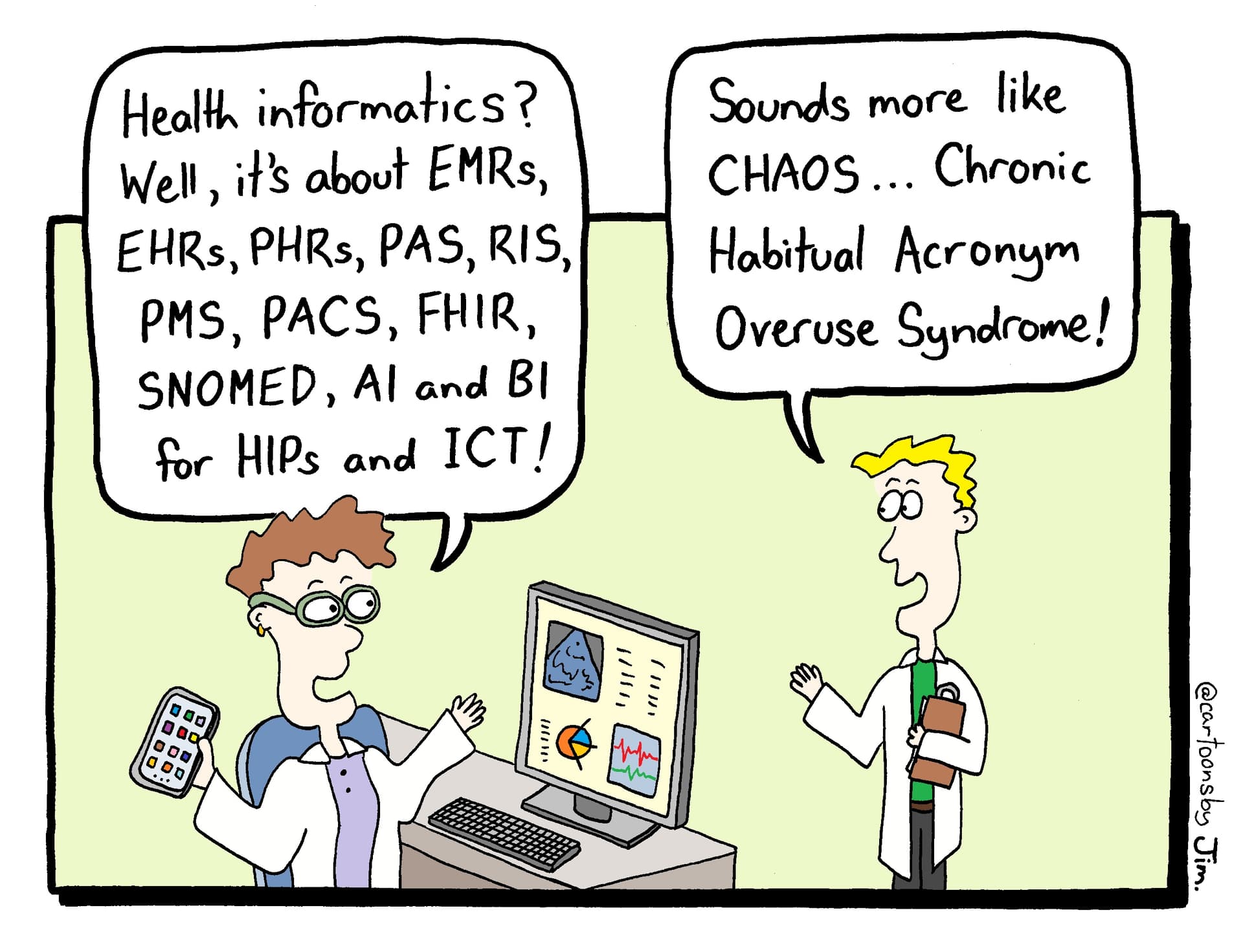
Does anyone see the need for a glossary of digital health terms, specific to us here in Aotearoa NZ? @Lara floated this idea a while back, and I’ve been tinkering with it since.
I recall my early days when dipping my toes into the digital health scene. In my full greenness, I needed to look up acronyms and terms what seemed like almost every minute of any group activity!
And I’m still tripped up by acronyms and abbreviations now - as well as sometimes not really knowing what several terms actually mean. It would be nice to have these written down in a easy-to-discover way.
Does anyone else see the need for something like this? Or be willing to contribute?
I think thats a great idea Nathan! I remember being new to informatics and writing a list of terms down from each meeting that i needed to look up what they meant, so i could understand what was being discussed.
I’d be happy to contribute what i can
I will upload a Glossary / Abbreviation / Acronym list that I created and placed on our Te Toka Tumai HIT MSTeams site for reference. I found I was being asked frequently by all staff members what various abbreviations or terms meant so I started the list 2.5 years ago and it has grown to 1575 entries. I encourage others to add to it as they come across new ones. If they don’t know what it is they highlight in yellow and then we can research what it means.
My apologies, as it originated in Te Toka Tumai is it Te Toka Tumai focused at present but I am keen to expanded it for a more national focus Glossary list.xlsx (163.2 KB)
List updated with Lara’s entries as well. There are now 1623 entries
What we can do here in the eHealth Forum is ensure that our national digital health community can easily take ownership of it and contribute to it sustainably (in a wikipedia-esque manner), whilst making it maximally discoverable via search engines and the like. Then it will potentially become a living resource for everyone’s benefit.
The key element is that we all agree to do it together and share out both the work and the benefits.
Practicalities within the eHealth Forum - a hybrid approach
We’ve got three key ways of tackling this (all linked together). These have been experimented with a bit and seem workable: you can check out the drafts.
Having a single wiki topic that includes all abbreviations and brief definitions in a table
this would be similar to @Lucyw’s spreadsheet, but not as complex
Nice! After spending a bit of time with your list yesterday, I’ve come to realise that there is a whole bunch of clinical terms out there which I take for granted - but these would likely be highly useful for those who come from a technical rather than clinical background.
With the help of ChatGPT, I’ve taken the liberty of adding a column and repurposing the Maori column to make a start on classifying the terms as per this:
Digital vs Clinical vs Te Reo (need to add Business)
Local (i.e. Auckland) vs National vs International
I’ve also stumbled across hinz.org.nz/page/AcronymDictionary, which is where I suspect your list started from. It has a nice insightful preamble and cartoon:
Health informatics is the intersection of the domains of healthcare, business and IT. Each of these domains has its own unique acronyms, so the marriage of all three was guaranteed to create acronym-soup!
As it is hosted on a static website (with an email-to-a-person mechanism for updates), it seems to have stayed small.
Problem Statement - the need for a Glossary
The problem is that we have confusing terminology and abbreviations across the digital health sector in Aotearoa NZ which impairs our communication.
To be effective, a glossary solution needs to:
Be easily accessible and discoverable (just in time) for firstly all NZ health informaticians, but also to all who interact with digital health in New Zealand (i.e. everyone)
Include a large number of terms from across the core domains
Allow for local terms which do not spam those in other areas
Be easily maintainable and sustainable
The spreadsheet is not bad for 2. and 4., but misses 1. and 3. A bespoke product to tackle this would be quite expensive (and a lot of work). The eHealth Forum could do 1. with aplomb, and be okay on 3. and 4. but will struggle with 2. It would also be a lot of work to set up and promote.
@Lucyw - I wonder if the best way forward in the short/medium term might be a hybrid solution:
host your spreadsheet in OneDrive rather than Teams and then expose it read-only to the internet
you control the edit rights (and grant them liberally to eHealthForum members as appropriate)
your usual crew simply follow the link to it
embed this into the eHealth Forum, where discussion about it can take place.
A glossary is essential. I used to get my undergrad students to create a glossary of terms from a one page summary of HiNZ conferences (you can get 55 terms into one page!). The real value was in the critique of the definitions that resulted in refinement and exploration of their contextual use. This is augmented by providing definitions as I teach (in quizzes, test-yourself exercises, guessing exercises).
For postgrad students I create a crossword puzzle and a large number of students seem to love it, despite the effort and time it takes to complete a crossword. The terms are reverse-engineered from the clues.
What would be gold is to create a publishable glossary augmented by ways for people to fast track the terminology learning with a discussion forum to practice and explore the terms, and some fun ways to learn them.
Thanks Nathan. I like the idea of categorisation but we will need to separate out the Acronyms that have different meanings into their own entries. There is also a fine line sometimes between digital and clinical where a digital product is used for clinical purposes e.g. Your Health Summary.
The HINZ list I added to my list two years ago. I have been picking up lists from multiple sources. Always good to check the glossaries in Business Cases or other publications as new one appear all the time.
It might be useful to see what people in other countries have done and leverage learning from their efforts. Here are some from a quick and dirty search on the Internet.
I did a Google Scholar search and these two articles popped up:
Fuller, D., Buote, R., & Stanley, K. (2017). A glossary for big data in population and public health: discussion and commentary on terminology and research methods. J Epidemiol Community Health , 71 (11), 1113-1117.
Benis, A., Grosjean, J., Billey, K., Montanha, G., Dornauer, V., Crișan-Vida, M., … & Darmoni, S. J. (2022). Medical informatics and digital health multilingual ontology (MIMO): A tool to improve international collaborations. International Journal of Medical Informatics , 167 , 104860.
Let me know if you want to explore this broader question about glossaries and I’ll set aside some time for it.
My quick scan of those sites reveals that they don’t meet any of the needs outlined above. They are thin on content, difficult to use, impossible to contribute to, and completely unfun!
MIMO (referred to in the 2nd article) seems much more comprehensive, but is utterly inaccessible in its presented form.
Maybe there is indeed a solid need here, and the eHealth Forum could meet it.
I think that would be really worthwhile and informative - please do!
I think that a glossary is a great idea. I recently moved to clinical informatics, and it has taken me a while to get my head around the acronyms and abbreviations. Often, abbreviations are the same, but they mean different things e.g., SLT is ‘Speech-Language Therapist’ and ‘Senior Leadership Team’. As a clinician, I used to refer to the approved abbreviation list if I was unsure. After moving to D&D I usually look up the terms on my search engine.
I would also like to see more consistency with terminology. Just in telehealth there are many different terms for the same thing which can be confusing – especially for patients.
Having spent the first few months in this role doing exactly this and realising it was probably going to be a full time job in itself I would thoroughly endorse this. @lucyw has a wealth of experience and has collated a really good glossary, great to have it available for wider use and I wish I’d had it when I first started.
I love this idea. I created an LLM Chatbot for the New Zealand health system recently and it’s got quite good at being able to answer questions from facts. It’s trained on a small lexicon of Ministry of Health and Te Whatu Ora content, adding a glossary to that body of knowledge would be useful.
Thanks Gabe! Nice chatbot - and good idea to apply it to the morass of digital health documentation out there.
Regarding this Glossary, @Lucyw and I are looking at the first step at the moment - establishing a single home for the data which is freely accessible and editable by appropriate people.
Once that is up and flying (and the data tidied up), we can work towards morphing it into the type of community-centred glossary that @KarenDay imagines:
Enforcing what others have said: I too am keen for a national glossary & am keen to be involved in making language clearer for all.
The problem we face is that acronyms and abbreviations create a barrier to entry for new starters, other professional groups and anyone that wants to provide input or seeks to understand the health sector. Their use demonstrates expertise, but it also siloes information & institutional knowledge, the latter being something I thought we wanted to avoid.
Perhaps CiLN and other groups could look to review the HINZ glossary on an ongoing basis?