I’m reaching out to hear your thoughts on developing a more technical skillset for people working /aspiring to work in digital health without a background in computer science or IT.
For those without an IT/coding qualification, what technical skills have you found most valuable to learn? Are there any you’d recommend prioritising—such as coding (e.g. Python), data analysis, understanding APIs, database management, using low-code tools, or even just learning how to use digital prototyping software?
I’m very interested to hear broad perspectives—what’s helped you work more effectively on digital projects, collaborate with developers, or contribute to innovation in your workplace? This is a common question amongst many clinicians.
The tech tool I use the most is Excalidraw. It is a whiteboarding tool. The other one I have tried is Miro.
Excalidraw is very easy to use - you can copy and paste images, logos, icons, screen shots. Then you can overlay arrows, boxes, circles, text etc.
I use it in a few different ways. I might sketch out a roadmap of features we’re planning to build, or map the flow of data across a patient journey. Other times I use it to visualise all the applications and stakeholders involved in a specific health IT scenario, which might help to better understand the context of a requested integration.
But mainly I use it for prototyping UI and then sharing the ideas with users or team-mates for feedback.
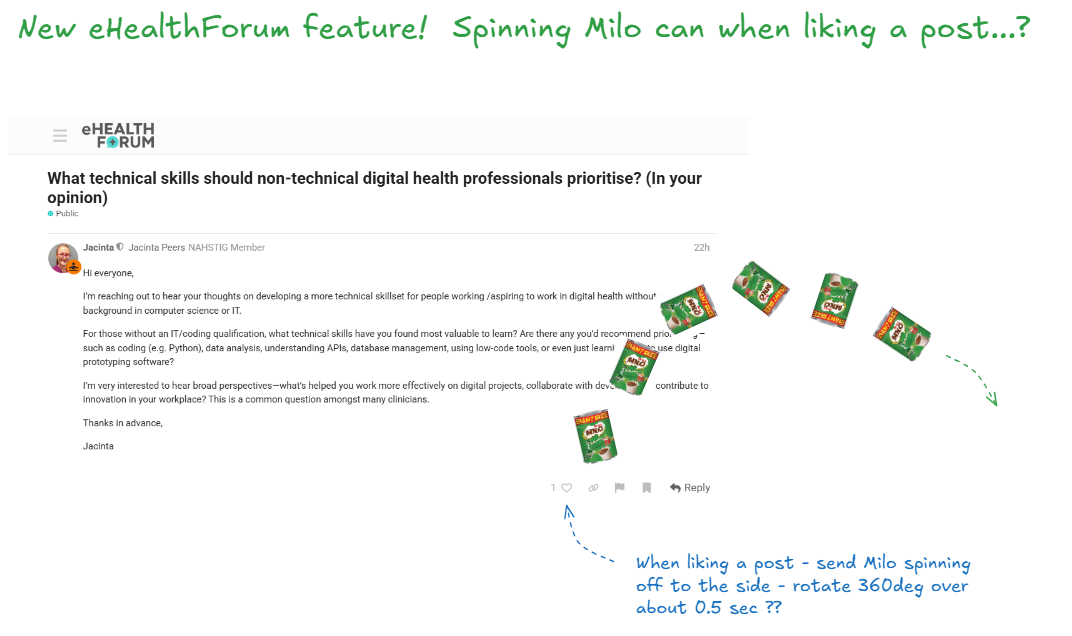
For example - I might like Nathan to build a new feature in the eHealthForum in an effort to gently lighten the mood within our community at the moment. So rather than trying to explain it in text I might create something like this:
I find visualising things helps me to understand things better, and can help me communicate more effectively too. Especially important when collaborating with engineers who will then spend precious time coding and bringing something to life.
HI there - I am a non-technical digital health professional. As for technical skills, I would say the basics: how to clear cache and cookies, how to reboot a computer and printer etc. And by far the most important thing is how integrations connect - like if I make a change to x application, where does this change go and what other applications would need testing for this change? How does the change I make, actually impact everything else around it.
Also, really good knowledge of healthcare business workflow is imperative and an understanding of govt policy and reporting requirements. So before I make a change in my application - is it compliant with govt and reporting requirements as well as current business process? Those kinds of things.
I’m in a Laboratory IT setting and for me local system workflow is the top priority. I would also be looking for people who have done some coding, it doesn’t really matter what language.
Beyond that, it would depend on the area in which they might be working. Learning some things like SQL can be done on the job, although understanding the data can be a bigger hurdle than the actual SQL code.
Interesting question, and I suppose it depends on why you need those skills and how you intend to use them. In my experience, learning a coding language is only useful if you intend to actually run some analysis or build something yourself, and intend to make this part of your toolkit. Learning a little bit may not do you much good because it’s still a language, and you need to practice languages regularly to be good at them.
Personally, I really do wish that a lot more people would make an effort to read up on and gain a basic understanding of how some systems work before they begin asking for them (gaining a basic understanding of data pipelines, for example). Technical staff would probably appreciate having a clearer direction being given by someone who has actually read a few papers on what they’re asking for.
Hey Jacinta,
I’ve been in IT for 38 years and the core skills for non technical IT people (we aren’t all technical in IT) have not really changed. The main areas where you can begin in IT without any qualifications or coding skills is in business analysis and/or process design areas. Later you can add data anlysis or solution design skills. All of these non coding IT skill sets require you to have a grasp of the diagrammtic methods by which ideas and requirements are expressed, processes are designed, and data flows and solution designs understood. The skill sets to pick up first, even in this day and age are: How to define a requirement, how to document a dataflow, a basic understanding of data attributes, and how to represent process flows. Books on these subjects can often by found in public libraries or second hand shops. But there is also a lot of free information online, e.g. Wikipedia. At a non-programming level, Information Technology is all about gathering and organising the business information you collect and documenting it in a format that others will readily understand, which usually means a form of diagram to a particular standard. There are a number of drawing tools out there. A free online one I would recommend as it has the templates to get you started is https://www.drawio.com/, which can be run on anything.
Hope this helps,
Robert
 .
.