This is the inaugural Hira update from the MoH, in case you are not on the email list:
December 2021
Welcome to the first Hira Update. This newsletter has the latest updates and where to go for more information.

In this issue
- Introducing Hira - an ecosystem of data and services
- Co-design with Māori
- Business case approvals
- Webinars
- Tranche one outcomes
- Tranche one workstreams
- Vendor update
- Case study - Management of medicines information
Introducing Hira - an ecosystem of data and services
Hira is a te reo Māori word that was chosen because it means “to have a significant bearing on future events” or “to have a widespread effect”.
This reflects the important role Hira will play in laying the foundation for a digitally enabled health and disability system that is people-centred, accessible, joined up and responsive to the needs of all New Zealanders.
Deputy Director-General for Data & Digital, Shayne Hunter, says Hira will bring together digital solutions and technologies that will transform the way people interact with health services and use their health information.
"The initial focus is on putting New Zealanders in control of their health information so they can better manage their health and wellbeing.
"At the same time, Hira will enable better clinical decision-making by providing health practitioners with secure, easy access to patient information in the right context and at the right time.
“Over time, Hira will form an ‘ecosystem’ of secure and trusted data and digital services. This will be a catalyst for establishing new, digitally-enabled models of care that will allow health and wider social services to be delivered in a joined-up way that can be tailored to meet the needs of individuals and whānau.”
When Hira is in place:
- Consumers will have better access to and control over their health information including updating their own NHI details and contributing their own data
- Trusted health providers will have secure, easy access to patient information, in the right context and at the right time
- Clinical decision-makers will have access to better data, which will support improved safety and quality, performance, planning, design and delivery
- Primary care and community-based services will be better able to respond to consumer need
- Vendors and innovators will have more opportunities to develop innovative health applications.
Hira services and functionality will be delivered progressively through regular releases across three tranches of work through to the end of 2026. Each tranche will deliver new services while also improving those delivered by previous tranches.
Co-design with Māori
To ensure Hira helps improve Māori health outcomes and targets equity challenges, Hira will be co-designed with Māori in a way that embraces te ao Māori ideals and practices.
The Ministry of Health has established Te Rangapū Tiriti partnership group, which will provide oversight and governance of this co-design work and contribute to decision-making on the overall Hira programme.
Te Rangapū will partner with the Ministry’s Digital Enablement Oversight Group and the Hira programme team to develop a joint roadmap, objectives and initiatives that will be captured in a Māori Digital Enablement Equity Plan.
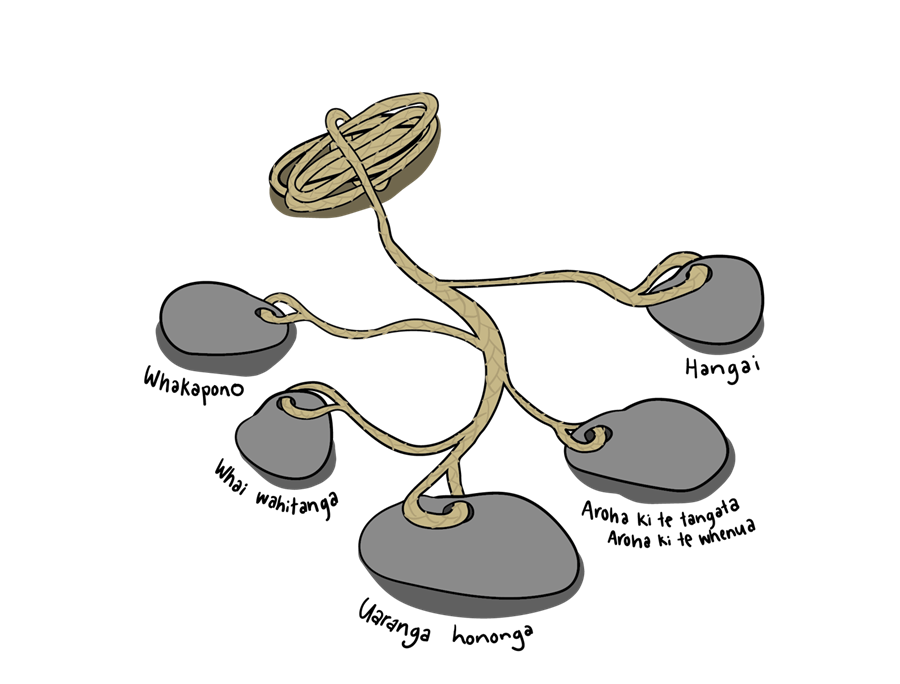
Within this governance framework, the Hira research and discovery team has been investigating what co-design between Māori and the Ministry could look like. Following consultation with Māori staff within the Ministry, the team has proposed using the concept of ‘nga punga’ or ‘anchor stones’ to guide co-design activities.
Group Manager Digital Strategy and Investment Darren Douglass explains:
“The proposed anchor stones will hold us steady but also give us flexibility – we can pull in the anchor stones and move our waka to a different area, changing our direction when needed. The anchor stones also allow us to adapt to the changing environment and be responsive. Depending on what we need to achieve our goal, we can select anchor stones that suit who we are working with and what we want to create together.”
The anchor stones proposed for Hira co-design work are:
- Whakapono - Turning our words into actions
- Whai wahitanga - Creating time and space to develop our partnership
- Uaranga hononga - Building trusted relationships together
- Hangai - Being reflective and responsive to what is needed
- Aroha ki te tangata, Aroha ki te whenua - With aroha for both tangata and whenua.
The Ministry will work with Māori and wānanga to test the proposed anchor stones and refine the proposed co-design approach.
“This mahi will be combined with the programme’s partnership governance model and both will be tested with Māori, iwi, hapū, whānau and co-design experts.
“What we’ve developed so far is just a starting point that will change with input from Māori and our iwi partners. It’s going to be a really different process to what we’ve done before. It’s going to be a discussion about how we can best work together, and how Māori and iwi would like co-design to work.”
Business case approvals
The Government has endorsed the detailed business case (DBC) for the first tranche of Hira and approved investment of up to $170 million over three years from the $385 million Budget 2021 package for health sector digital infrastructure and capability.
Work to deliver Hira tranche one has started and will be completed by around mid-2024.
The DBC for tranche one will be published on the Hira webpages in due course once appropriate consultation has been carried out to identify whether any commercially sensitive information may need to be withheld.
The overarching programme business case (PBC) for Hira was endorsed by Cabinet in April 2021. A copy of the PBC can be found on the Hira webpages.
Webinars
On 10 December 2021 the Hira programme team delivered in-depth stakeholder webinars for:
- the health IT industry and innovators
- health and disability providers, clinicians and consumers.
Around 1,000 people from across the health and disability system attended the webinar livestreams.
“It was fantastic to see such a high level of interest in Hira and an exciting opportunity for the team to outline the programme and answer some of the burning questions from participants,” says Group Manager Digital Strategy and Investment Darren Douglass.
“We didn’t have enough time to answer all the questions we received on the day, but we’re working through them and will provide a summary of the themes and our responses in the next issue of the Hira newsletter and on our website.”
You can watch either webinar by clicking on the relevant tile below. The slide decks prepared to support the webinars can be found on the Hira webpages.
Tranche one outcomes
Currently, health information is stored across a range of systems and providers. The time taken to collate this information can create delays in care and put patients at risk.
Hira tranche one will address this by allowing New Zealanders and their chosen providers to use their smartphone, tablet or computer to access important health information.
In the first instance, this will include:
- basic patient information such as gender, ethnicity, name and date of birth
- enrolments and entitlements
- medicines
- COVID-19 vaccination status and diagnostic test results
- summary primary care data
- other sector data services.
Regular releases during tranche one will see a broader range of health information become available over time, along with expanded access to Hira data sets.
Hira tranche one will also put in place many of the elements needed to lay the foundations for a digitally enabled health and disability system, including technology enablers such as digital identity and interoperability services.
Tranche one workstreams
Hira tranche one has six core workstreams:
The data services workstream will oversee the provision of application programming interfaces (APIs) to enable a person’s health information to be brought together from different trusted sources and viewed as a virtual electronic health record. This is the foundation of all Hira products and services.
The channels workstream will allow consumers and health providers to access, update and share relevant health information using Hira products and services. A marketplace and developer portal will be established to provide access to Hira products and services and to allow developers to find and connect to APIs.
The operational services workstream will establish an adaptable and evolving operating model to ensure secure and stable Hira services. This includes a certification framework to ensure people and organisations connecting to the ecosystem contribute in a positive way and comply with applicable standards.
The identity workstream, building on the My Health Account initiative, will deliver the technical components needed to ensure a unique digital identity is in place to manage safe and secure access for each user of Hira services.
The interoperability workstream will provide an event notification service to notify relevant parties when changes are made to individual data sources, and an integration platform for securely drawing together health data from different sources. This will create opportunities to streamline processes and automate workflows while eliminating redundant and/or duplicated data entry.
The change and adoption workstream will support health consumers, providers and developers to adopt Hira and get the most out of its products and services.
Vendor update
We appreciate the New Zealand market is highly motivated to help us move forward with Hira.
Vendor responses to our request for information (RFI) were much appreciated and provided valuable insights, learnings and input which have informed the thinking and planning for Hira’s next stages and helped define tranche one requirements.
The Ministry has now developed a commercial framework to ensure Hira procurements support innovation and value for money while providing a level playing field for all vendors. A draft accreditation and certification process to ensure participants have appropriate clearance and qualifications to access, consume and/or develop within the Hira suite has also been developed.
We expect to hold targeted workshops with health IT industry participants in about March 2022, to work through some technical aspects of Hira tranche one.
A procurement plan for the initial Hira releases will be confirmed in early 2022. Procurement opportunities will arise on an ongoing basis throughout the programme, which is expected to run until around the end of 2026.
Case study - Management of medicines information
Medications are critical for managing many health conditions. However, New Zealanders and their health providers are often unable to view a complete and up-to-date list of their medicines online. This means clinicians may sometimes need to make treatment decisions without all the information they need, risking patient harm.
Workshops carried out by the Hira research and discovery team confirm that this lack of visibility and access, together with a lack of interoperability between primary and secondary care systems, is a cause of great frustration for many health providers.
Health providers have told us they see significant value in having a medicines data service – a trusted way to access their patients’ medicines information.
Work is currently underway on what a Hira-enabled medicines data service might look like. The initial focus is on enabling access to information rather than creating the end-user channels for accessing this information.
As a first step, the Hira team has worked with clinicians to develop ‘use case’ studies that capture some of the key ways medicines information is used or required at different points of care. This is informing the design of the medicines data service by asking questions such as what data is required for a medicines reconciliation process or for a medicines change process, what data needs to be accessed, and what data needs to be sent back to the prescribing and dispensing systems?
Next steps for this work include seeking consumer input and working with the Health Information Standards Organisation *(*HISO) to update the medicines data standards.
The outcome of the project will be to introduce a modern application programming interface (API)-driven approach to accessing medicines data, in line with the overall Hira approach.
Questions or comments
We value your thoughts and feedback about Hira. To contact the Hira programme, please email contact@hira.health.nz.