Electronic Patient Handover

Hi all,

I was wondering if anyone is aware of if digital solution exists for patient handovers?

I am working with members of a project team who are developing a patient centred handover template/form. They would like to standardise and digitise the form become part of the patient’s EHR.

Currently the process is inconsistent and may exist as verbal or paper-based process, with a variety of forms that are used and often not completed correctly nor designed for the recipient of the patients.

If anyone is aware of any current or potential solutions, please share!

Many thanks

Dale

Hi Dale,

I am not sure if these are what you are looking for but the two that I have had experience with are Nimblic’s MedTasker and Alcidion’s Smartpage. They are both good products and choosing between them comes down to other site-specific factors or personal preferences.

Kind regards

Greig

3 Likes

In 2019-2020 we went to the market for an eObs & Handover solution. Nervecentre was selected.

Cortex ? Saxon Connor at Canterbury speaks highly of it.
Integrates with Orion Health Clinical Portal

@Alistair @sax

Hi Team

Clarification three different types of handover of care

  1. Referral / Discharge Summary when transferring referring a patient to another organisation, or advising end of episode of care and transfer back.
  2. Service Handover, when a service transfers within an organisation, on the expectation that all the notes from the episode to date will also transfer. For example General Medicine to Older Persons Rehab.
  3. Shift handover . . between caring teams within a service, typically at the change of shift.

Handover of Care - Shift Change or Service Handover (2 + 3 above)
Anticipating that this is what is meant by handover of care in this context.
Handovers of care are one of many risky transitions that occur (risk for the patient).

The product is not the solution to the clinical problem, you can have a great product if the communication is poorly documented, you will not have fixed the problem.

A well understood format for handover of care is the SBARR format
Situation | Background | Assessment | Recommendation | Response
Originally developed for use on Nuclear Submarines for communication within high stress environment
Sometimes iSBARR (with an initial ‘I’ - Identify yourself).

With a form template builder of any merit the simple SBARR structure where every field is required will ensure safe transfer of care across these clinical transitions. Will need clinical training to support this structure.

1 Like

The two I suggested were built specifically with Option 3 in mind. I am not sure about Option 2. They are products to migrate the system from a pager-based system and paper notes to an integrated electronic task manager.

This is exactly what I was thinking when I read the first post…

Looking at your background @DaleMajer - you might want to talk to the @NAHSTIG if this is an Allied Health thing - @Sharonrussell is looking for topics/items for meetings next year.

Jon

2 Likes

Thanks @jon_herries - we can ask the wider group. Nothing comes to mind however there are better minds than mine who may be able to answer this question. @Sharonrussell and @GPaterson may know.

In Christchurch hospital campus, we use cortex in the allied health space. It really depends on what is needed. Allied health here have the flexibility to create whatever we need our want to get standardized information, i.e. Form filling.

It works well as a referral, orders, quick check in with other clinicians, at the same time it is our electronic patient record. What I feel this does well, is that it is agile enough that we can change the forms and fields according, which changes people’s behavior. When we get it right, we only get the data and information we need none of the extra info we don’t want.

The added plus of having total control of the data we are gathering, we also use it to capture what is needed for our CCDM information and we also use these data points operationally on PowerBI to help inform us on demand and not too far away… Predicted demand.

Yes, Paul I was thinking the same. Like many things you wonder if an electronic form could incorporate some standard information, but the structure be adaptable to suit different clinical environments and situations. Nursing handover is different to Physio, Nursing handover differs from post-op, to ED, to ward. Can you look to Australia or UK to see what they have implemented successfully? Good luck Dale and team.

1 Like

Hey Dale, I have tried to implement a tool for option 3 a few of times.

This may sound like heresy, but I have found for ICU handover from one team to another, that the best solution is a word document on a hospital system drive. Nomatter what tool you choose, it will flounder or flourish based on clinical team members preparedness to both add and delete information to the handover document. Consider also that there is a common desire to be able to pass on information to the receiving team which clinicians are reluctant to write in the notes.

Whatever tool you use needs to be easy to modify, or information becomes rapidly out of date.

Consider the following : preparedness to “delete” or modify something from the handover information is commonly influenced by perceptions such as “am I allowed to delete something?”, “Should I delete or modify a problem which a more senior doctor entered?”
A fascinating and insightful handover workaround was nurses who wrote their handover information on paper towel - specifically so it couldn’t be filed in the notes.
Problems lists which pull from structured SNOMED or other lists can be hard to articulate exactly what you want to say to the receiving team, and the additional time to enter or modify a problem becomes a barrier to keeping information current…

I did find that Orions problem list was challenging to use from a usability issue. If you want more discussion on that, check out the following discussion from 2019, which basically outlines “the problem with problem lists”

https://ehealthforum.nz/t/orion-problems-list/9470/3

Hope that helps.
Mat

3 Likes

Hi Dale,

Elsevier provides evidence-based Care Plans. Snomed coded and incorporates Nic, Noc and Nanda nursing classifications in order to benchmark and compare nursing inputs with other institutions. The approach intends to re-inforce evidence based decision making.

At the Imperial College Healthcare NHS Trust, implemented 240 interprofessional care plans in under a month.

1 Like

Hi Dale,
Perhaps you could clarify what you mean by “patient handovers”?
Is it primarily for IP nurse to nurse at shift change time? or something else?
Does it include the handover of outstanding & periodic tasks?
What the the problems with the current state? What benefits are you looking for?
Murray

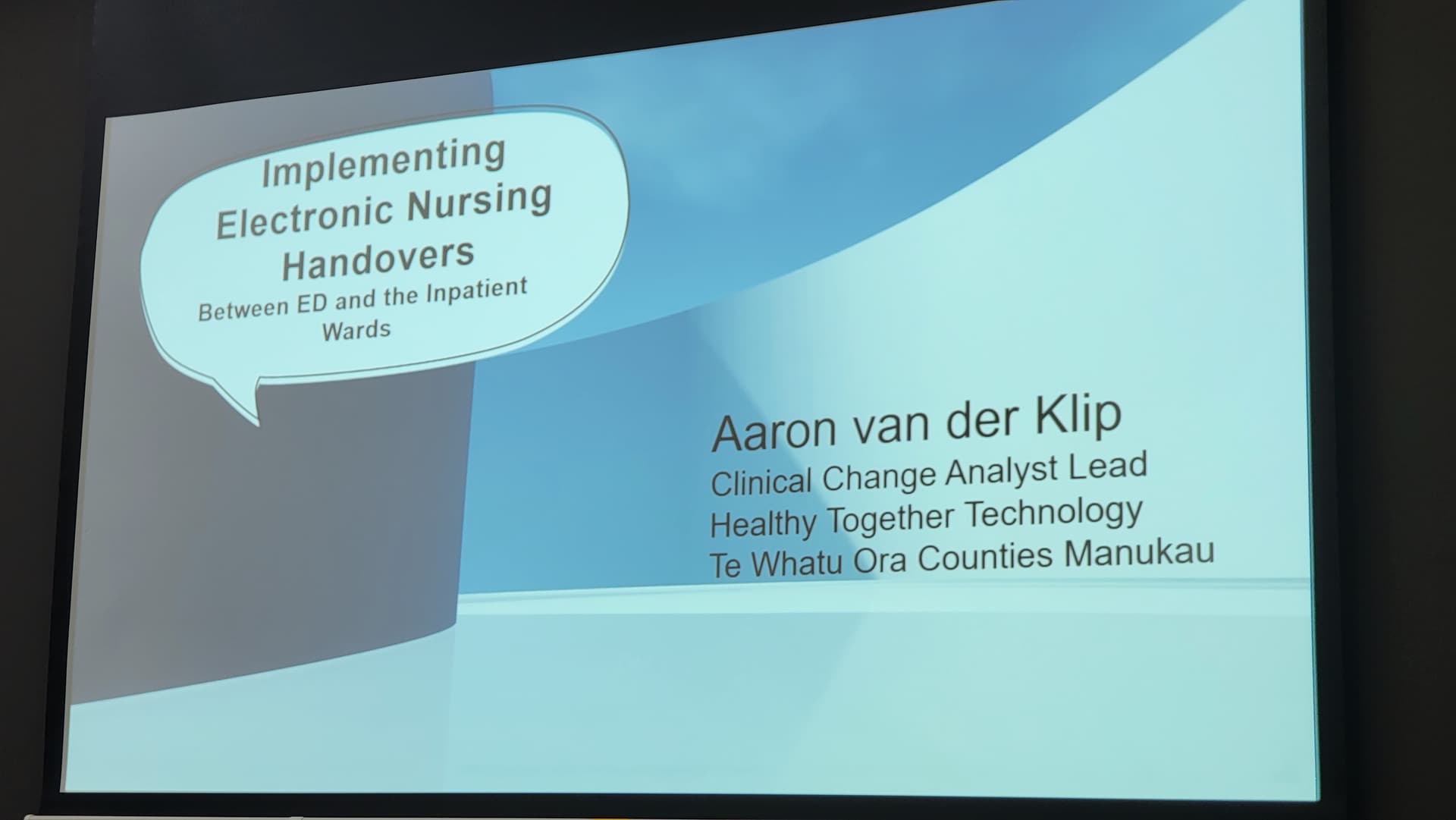
@aaronvdk’s presentation at the moment!

Aaron, do you have any thoughts to share on this?

2 Likes

This report describes how University Hospitals of Leicester (UHL) has transformed the clinical handover process across five surgical wards to improve patient safety, increase clinical accountability and address concerns about information governance.

1 Like

Hi all,
Thanks @NathanK for the tag!

I think I would lean towards adding a 4th scenario to the list - or at least, adding it as a sub-item of #2 (service to service transfer/handover), where the nursing handover between services can differ in terms of the type of information that is handed over. For that reason, I think it needs to be called out as it’s own thing or own sub-class of another as the information handed over differs even from a shift to shift nursing handover.

My presentation was around the ED to Inpatient Ward Nursing handover - so that sub-class of specialty to specialty handover.

For this, I have utilised Orion’s Portal and Care Pathways forms to create our solution. The solution developed broadly follows the SBAR type format, but with added structure to capture the necessary information as required.

Within our district, we have an Orion Referrals platform with integration from (I think) Health Pathways (which the GP systems can integrate with) for scenario 1 (GP to Hospital transfer) with the reverse scenario being just a copy of the Discharge Summary / Transfer of Care document being sent back to the GP. There is probably work to be done in this space.

For Medical team to Medical Team handovers, we are currently moving them to the same eReferral solution as for one but setting up different “Inboxes” so that clinicians can identify the differences between Inpatient transfers and outpatient referrals.

Finally, for shift handover, as I understand it, Nursing staff are using TrendCare and our Medical staff have a report generated based on the TrendCare Nursing handover, but with patient grouped by medical team rather than ward.

I think the really key aspect to a successful handover solution is to have it work with the workflow of the staff involved - if you can allow them to complete multiple tasks within the same system / ecosystem, then you’ll get a much greater buy in.

I believe there is more work to be achieved on all 3 handover scenarios and am keen to hear the ideas on others on how we can potentially improve all 3 scenarios, and then seeing how and where we can put them into practice and trial. It’s highly likely that it will take multiple steps to get to the final state, and we may never get there (continuous improvement), but every step taken will deliver benefit and teach us something more for the next iteration.

I’m quite happy to be contacted by anyone wanting to know more about our ED to Ward handover solution, and can do my best to further explain our other handover solutions (or put you in touch with someone who knows them better).

2 Likes

Hi everyone, I hope everyone had a great time up in Rotorua for the HINZ conference & thank you all for your responses to my post.

To add a little more context the group I am working on are Nurses who wanting to standardise patient handovers between different in inpatient departments - they are looking to pilot this between ED and the Cardiology ward in Wellington Hospital. Currently the Nursing handover takes occurs either verbally - telephone or in person, paper based or not at all. The iSBAR, along with other variations of paperbased forms exist howveer this is to a varying standard.

Their goal is to use a digital tool which can be modified to become patient centred and also ensure the department that is recieving the information is being sent the key information. The group have held workshops with key stakeholders to identifty the type and quality of information they think should be included in the template.

1 Like

I’d echo much of what’s above – these sorts of digital handover tools exist in multiple centers. I probably would encourage your pilot team to reach out to the other major centers to see their tools as a potential template.

4 Likes