Electronic Admisison Notes - what systems are being used in NZ?

I’m interested to find out what systems are being used in NZ for RMO admisson clerking notes for inpatients.

Our default system is paper based, but many RMOs are using their own word document templates, and then printing the admission note out as they prefer to type.

Options to capture these in the Orion Clinical Portal (i.e. Concerto or Health Connect South (HCS)) could include:

  • SMT (Soprano Medical Template) documents
  • Care Pathways documents
  • Other 3rd party document generator that exports a pdf to the Orion Clinical Portal.

The ideal medical admission note would pre-populate with known information about a patient (such as past history/problem list, medications) and then be able to be edited by the RMO prior to being saved. Then also have information and task delegation automatically flow to subsequent stages of the patient journey. We are some way off achieving this, so in the short term it is likely to be better to go with something simpler to start with.

Is anyone regularly using electronic admission notes for any of their hospital services and if so what systems are they using?

1 Like

Hi Damon,

Answering from an Auckland region RMO perspective.

Waitemata DHB uses Soprano Medical Template Documents to do so, and thereby prepopulates some parts of the admission note (e.g. Past Medical History) into the Discharge summary automatically.

Auckland DHB for some services (e.g. Gen Med/OPH) also uses this method though not as commonly, and other specialties such as orthopaedics use a different 3rd party tool called Scope for their admission notes.

I have not worked in Middlemore so I am not sure if they have the same style admission notes as Waitemata DHB yet.

Cheers,
Mark.

Hi Damon
I believe in Northern Region CMDHB, WDHB, NDHB and ADHB all use Soprano Medical Templates for this, slightly different templates.

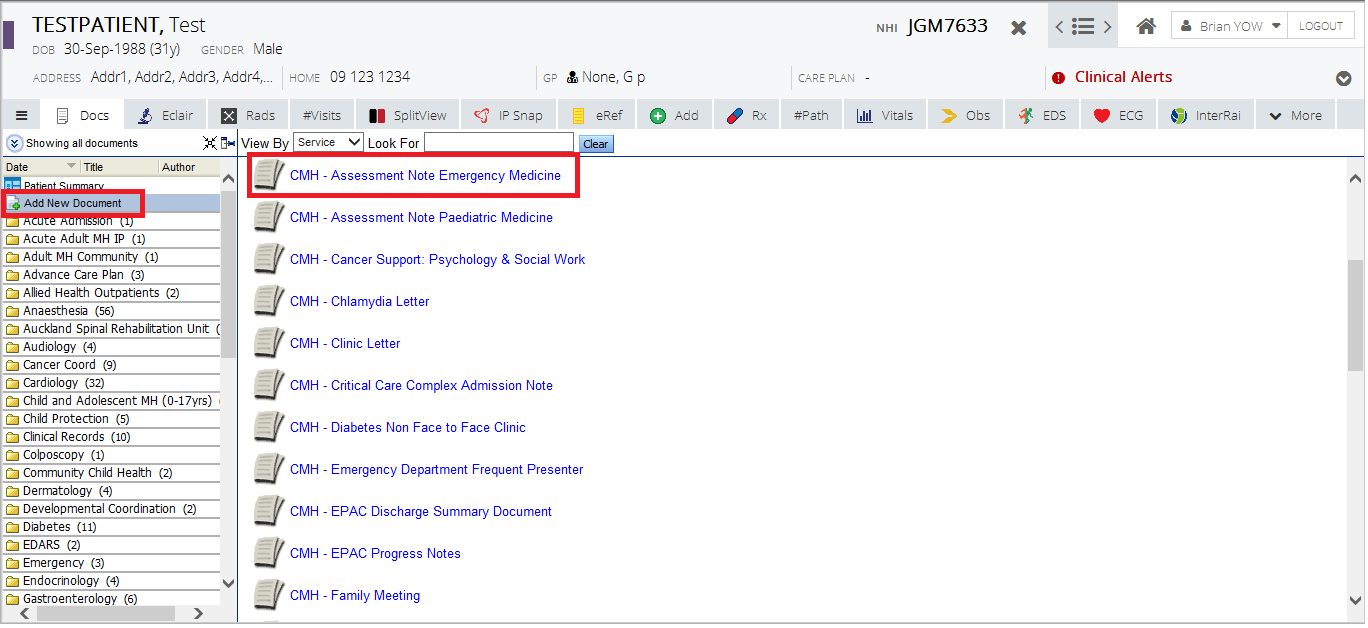
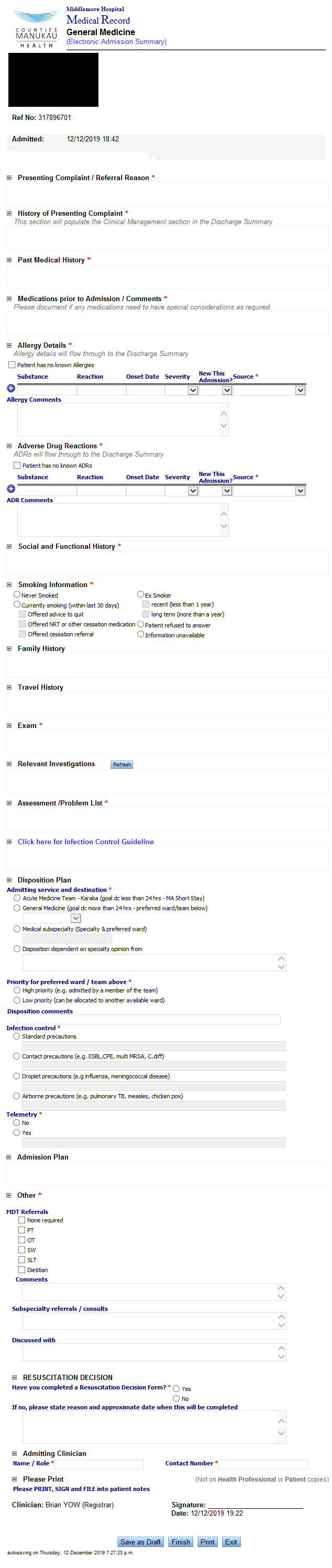
At Middlemore we populate Past Medical History, Allergies and ADRs from the most recent Discharge Summary in last 3 years (otherwise will return as blank). The admission template then flows through to the EDS for the same admission e.g. the history of presenting complaint populates as the start of the clinical summary in EDS.

We are moving to Care Pathways and want to learn from Midland Region ETOC for A-to-D.

Cheers
Brian

Thanks @markbekhit and @brian.yow for your responses. Can I ask some points about the use of SMT for admission notes:

  1. Do you know if the SMT admission note is required to be linked to a particular admission?
    a) If yes, then how do you deal with the situation where the note is created by the specialty registrar or house officer in ED pirior to a decision being made whether to admit the patient or not (and hence no admission number yet available to associate with)
    b) If no, then how do you associate the admission note with a particular Consultant (or do you not bother doing this, or does the RMO writing the note manually select their consultant)?

  2. If you are pulling past hx, drugs etc from recent discharge summaries, have you had any issues with RMOs not updating these sufficiently for the current admission?

Regards
Damon

Hi Damon

In ED we did it with SMT adhoc, as some clinicians still prefer to do it on paper. The adhoc avoids the encounter number issue and it’s completely optional. The other specialties e.g. Gen Med, OPH, med subspecs we did it with the episode linked SMT. There’s different SMT rules and limitations for things like pre-populating for adhoc vs episode linked, so pros and cons

Overall something like 90% are electronic now, was a gradual conversion rate. Basically all the night staff find it easier to handover electronically, everyone can read it at handover/postacutes/legibility/visibility etc

You are right there are some things to work through with the iPM encounter numbers (our PAS), transfers from ED to other departments can cause issues sometimes

Our ED guys are now asking to remake their admission note and look at doing a streamline data flow populating from A-to-D from ED to Gen Med to OPH for example - maybe we can have more functionality doing this with Care Pathways instead

We haven’t done it in Surgical specialties due to faster workflow, only doing it now starting in Ortho. WDHB have implemented it for all specialties I think

You are right there are definitely ‘copy and paste’ syndrome problems with pre-populating. The balance is whether we want busy admitting clinicians to have nothing vs something to start with

Although I think (perhaps naively) this would improve if we did implement end to end electronic notes, including inpatient consults, progress notes, Ward rounds etc. If people see the value and the majority try to at least glance through it and update it a little bit then it might reach critical mass and stay reasonably accurate/current

Although we are still missing GP (we don’t have HealthOne) and of course the patient (can’t wait until we finally get a patient portal) so there are significant gaps

We are also looking at the Orion Read/Write/Reconcile Problem List that has 2 way population with Care Pathways. So then the PL might become source of truth and that surfaces in every admission, EDS, clinic letter, ward round note etc. Then at least it is visible at various points of clinical workflow to encourage people to look at/update it at multiple points of care

There’s a regional discussion occurring re Problem List (both the concept and the Orion application) and data strategy/architecture. @jenp our Counties Programme Manager and @Tina.Sun Clinical Director IS sit on HSDC Health Services Design Council where this is tabled and will be valuable to get their input. @lara is on that from WDHB side and she has always been a key pillar for Clinical Informatics in the region :slight_smile:

1 Like

Morena

Care Pathways is one of the modern tools intended to do just that. There are various admission and assessment forms available in Care Pathways.

Thanks for your interesting account of how this is working in the Auckland region @brian.yow

Can I just clarify how it would work in this hypothetical, but very common situation:

  • Patient arrives in ED.

  • Seen in ED by ED doctor. Notes recorded in an electronic ED system.

    1. Would this initial ED note be in SMT or something else?
      (For us the initial note is in EDIS, a different system altogether)
  • ED doctor requests review by specialty registrar eg Med Reg.

  • Med Reg or House Officer sees patient in ED and makes notes on their assessment, which may also double as an admission note.

    1. Does this Med Reg/HO note get attached to the ED event or the inpatient event?
      When they make the note, a decision to admit may not have been made yet, so they may not have an inpatient event to attache it to. Or does the Med reg make a brief note then the HO makes a detailed admission in the Medical Assessment Unit once the patient has an admission event? Or does it just pull it through from the most recent admission note within a given time period
  • Patient eventually gets discharged some days later.

    1. Is the pulling through of the problem list etc from the admission note to the discharge summary dependant on the admission note being associated with the correct inpatient event?

It would be great to see some examples of your admission templates if possible. Perhaps I should come and have a look at it in action next time I am up north!

Kia Ora @JaniceinCoro! Thanks for your comment on this topic.

Yes from what I know of it, Care Pathways would have a better integrated function for this, but as I understnand it also takes a fair bit more work to set up. So for a quick fix for the short term we are still looking at the older SMT options.

I would be interested to hear though if you have had any direct experience with Care Pathways in any setting and how this was used?

Hi Damon

We have had the paper A-to-D planner for number of years it’s a pink booklet including Triage Clerk, Nursing notes in ED etc. The ED doctor can either write in that or optionally type up SMT Adhoc Admission Template and then print and stick it in where the doctor usually goes. People can refer to the paper copy in a hurry but it is also visible in the Document Tree in Clinical Portal.

The ED template I think was set up first number of years ago without pre-population in mind (the sections have to have same SMT section codes to populate between templates).

We also use Orion’s EC Whiteboard product. ED often keeps the patient if they are discharging in few hours but if they are likely to stay overnight then they transfer the patient from ED to say Gen Med on EC Whiteboard. That then auto-updates iPM (PAS). The iPM encounter changes from Emergency to Inpatient.

The Gen Med House Officer/Registrar then sees the patient and they pretty much always do it electronically now and stick it into the paper folder. We do this with the SMT Episode-linked admission template (it’s partly because of the PAS encounter/our business rules but there’s no reason you couldn’t make both the ED and the Gen Med using SMT Adhoc or vice versa if it fits your workflow).

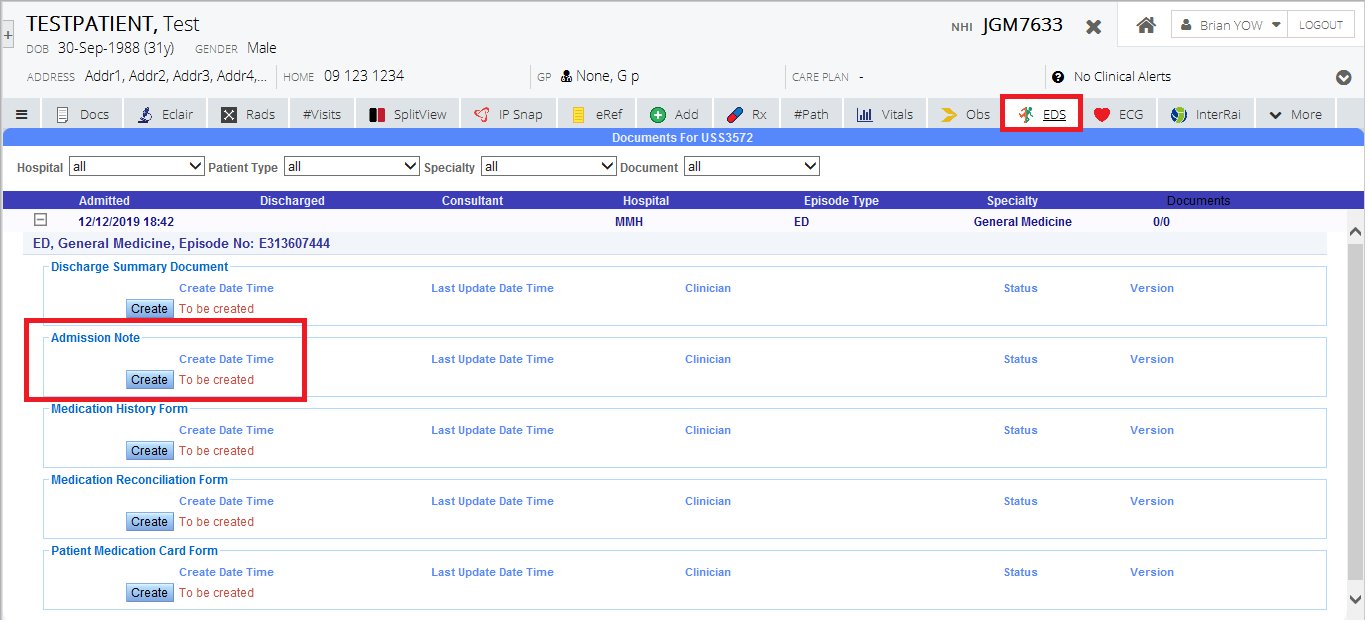
The episode-linked SMTs are under the ‘EDS’ tab (historical naming we’ve had suggestions to change it to something else)

The Gen Med SMT episode-linked admission note gets attached to Inpatient Event.

When the patient gets discharged (may occasionally be same day), on creation of the EDS, some sections gets populated through. Note the display name can be different e.g. History of Presenting Complaint on the admission note pulls through to Clinical Summary in the EDS, as long as the SMT section codes are the same.

There are some rules around population e.g. you can set it to pull from previous template of same type, or must be same encounter, or any previous template within x days that has the same SMT section code. I forget the exact details but it’s not as advanced as Care Pathways. From memory we went with pull from X days ago, set at 3 years to search for a previous EDS (because if the encounter changed from ED to Inpatient then it wouldn’t pull through).

I learnt most of this from our lovely SMT Functional Specialists at Counties, WDHB and Health Alliance.

In short term definitely you can churn out SMT quite quickly. Our ED guys are thinking of remaking their SMT so it’s all joined up with other departments - but again pros and cons with adhoc vs episode-linked. Longer term definitely better to do with Care Pathways and have ward rounds in the middle.

We are more than happy to do a Zoom teleconference or you are welcome to swing by if you are around Auckland. Likewise we would love to come see what you are up to :slight_smile:

Cheers
Brian

2 Likes

Hey Folks,
Coming to this discussion a bit late - Damon, it may be worth having a chat with some of the OH guys who work in the Southern Region. (?Jacquie Williams (Nee Hoey)?
As you identified, Care Pathways is a better way to do this, but takes more set-up time. What has shifted in the last little while is that OH has created a Care Pathways toolkit type of functionality, so that form building is easier. It’s still not quite as simple as SMT (cause the new product is more complex) but seems to have potential. We have been working on this for a while, and are hopefully going to have something to show for it in the next couple of months. For our teams and clinicians, it has become a bit of a paradigm shift, as SMT has been the available product, and is a “static document” while Care Pathways is much more designed around the notion of multiple, re-usable data elements… trouble being that it needs those data elements to exist and you have to make them.
Happy to discuss - give me a buzz!
Mat