CCIO update: Data and Digital - Clinical Informatics for the future

First up!

I encourage everyone to visit the “what say you” link and register to consult on the Data and Digital consultation document, which will be available until the 12th of May.

https://tewhatuora.wsy.nz/

If you’ve previously experienced ‘restructuring’, you may be inclined to cynicism. Don’t do this! We are in the midst of a fundamental shift unlike anything I’ve seen in my 30 years of medicine. There is a strong will for change. Have your say in how we fix the architecture of our currently languishing health care system.

Where am I now?

I am currently on the data and digital road show. We have held 11 different face-to-face meetings, and 6 virtual hui. Each one has been different and each one has fed excellent ideas into the new system.

We are adapting to the feedback. At one of the first meetings, I was asked for my ‘elevator pitch’ for the informatics line within the new structure. Here are my—progressively evolving—thoughts on the topic:

CCIO Informatics elevator pitch

Pae Ora identified two fundamental problems:

  • Local optimization getting in the way of global excellence
  • Failure to achieve true partnership.

These can only be fixed with new thinking, real change and if we strike a balance between the components of our new system. The establishment of Te Whatu Ora and Te Akai Whai Ora is a huge step in the right direction.

Clearly, the most important component is people: starting with those who together with their whānau are seeking health — and including all of us, across all professions, care settings and varying current levels of digital capability.

Here is where Clinical Informatics comes to the fore, both within and outside Data & Digital. We ease the flow of information, translating and providing context that makes this information meaningful. We do this:

  • At all levels we act as the glue between Hospitals and Specialist Services, and Service Improvement and Innovation; and
  • Internally between the eight streams of the Data and Digital business unit.

Although you currently see streams called ‘clinical informatics’ and ‘integration’, the things that really matter here are the functions and capabilities of all of the various streams of data and digital, and our ability to pull together virtual teams (or guilds) based on capability, capacity and skills.

This how we can translate national design into regional alignment and ultimately, local tailoring. In other words, we counteract tendencies to adopt a ‘managerial top down approach’ using local knowledge of what works on the ground.

At this point my pitch stops at a floor

I’m supposed to go …

And this is the answer…

That’s not how things work here!

I don’t believe our current, tentative structure will get us where we need to go. There are still missing pieces. There are likely pieces that don’t quite fit. This is precisely why I’m on the roadshow. Why I’m listening and learning and thinking how we can adapt.

It’s easy to cling to the status quo. This won’t get us anywhere. It’s easy to repetitively try things that haven’t worked in the past—hoping this time it will be different. That’s a fixation error. It’s easy to feast on low-hanging fruit, but that also will not get us to the next step in the complex, adaptive pattern we need to weave.

You have given me a number of good ideas and suggestions already—but what will really help is your continuing to provide these. What will help even more is where you explain the thinking behind your suggestions.

The way forward—some foundational ideas

The above might seem just too vague. Here are some more concrete principles for you to criticise:

  1. Mere belief is not enough. We must tease out wants from needs. We need to review both, but if we try to please everyone, we’ll end up pleasing nobody. We must address needs.
  2. We have already identified areas of excellent function, but in the past we have failed to translate this excellence across the country. We must fix this mode of failure, and start to grow the good.
  3. Architecture is important. Especially with modern information technology, there’s a tendency to hope that the data will start speaking, and miraculously transform themselves into coherent, contexual information. This won’t happen. Not only are data mute, but even fancy AI will struggle to put data into place if they have initially been robbed of context. Relationships are as important as ‘data points’.
  4. Every subdivision of a problem is potentially a silo in the making. The way to prevent this is to start from common ground, and share information, ideas and frustrations as we grow. We need friction to wear away the sharp edges, but we also need the lubrication provided by free flow of information. (This metaphor may need some work :​)
  5. The real enemy is complexity. There is no problem, however complex, that a bit of injudicious fiddling can’t make more complex! Conversely, once we’ve delineated the foundation—and where and how it should be built—a lot of the complexity can be put in its right place.

As New Zealanders, we’ve often been rightly proud of our innovation. But we cannot be backward-looking, focussing on successful past innovation, especially in health care. If we identify solutions that are hard, that should not dissuade us, provided they are also necessary.

If this were easy, others would have done it properly, already. They haven’t. I believe we can.

Have your say

Please comment in this forum. I will read and value your comments. This is, of course, informal communication in a safe, closed forum.

I would also strongly encourage you to give feedback on the official site:

https://tewhatuora.wsy.nz/

This has many advantages. You can weight comments and discussions by upvoting them, and submit official feedback. You can read a number of the other business units’ consultation documents. The document I’d single out for scrutiny is this one: Service Improvement and Innovation.

Lara

11 Likes

Kia ora @lara
Many congratulations on your new role.

The ‘what you say’ link indicates that registrations are full and no new ones being accepted.

A quick suggestion to add to the list and from simplify to unify, and from your comment around local prevents global excellence - i would like to add ‘evaluate to communicate’.

We do great work but often fail to incorporate evaluations into the projects, then even if we do evaluate, the lessons learned are not shared, we fail to communicate so other can hear. We do not communicate best practice or share well what each each region, district, organisation or individuals are doing. In addition we don’t communicate many great ideas and even if some are communicated, we don’t listen to them. Listening being part of communication.

Even though i don’t work clinically any more (only an academic now) i see that different sectors still often talk past each other and so we fail to take advantage of local successes and turn them into global success.

I would be happy to discuss further
Cheers Inga

2 Likes

Thanks Inga

Have escalated to the people who can help with the what say you

Allows me to not out how important feedback loops are - especially when it’s this easy to give feedback :slight_smile:

Happy to have informal feedback here - and think you are 100% right about taking past each other, failing to communicate and failing to do continuous quality improvement - measuring things and changing based on measurement - not setting targets and trying to hit them

I think there is the converse issue with failure to communicate - we also have a failure to listen happening. I have listened to what i have just written and want to reassure you i am listening.

I had some feedback early on in the roadshow, by a “don’t work clinically anymore” person worrying that my decision to continue doing clinical work, would bias me towards only wanting clinical informatics who have an annual practicing certificate. I work because it’s my space and it gives me pleasure, not everybody has to be active clinical to have the ability to move in both worlds.

And conversely - that is why I’ve moved my CCIO update to the general channel. I did my first one on CiLN and then realised i was excluding a large part of the team. I do have a real belief in working together, and this is my way of demonstrating this. I am also aware we have informatics team members who are not clinically trained, but have massive clinical insight - the “underwater welder” analogy

Lara

5 Likes

There are some really good comments and question in the Clinical Informatics section of the D&D restructure on What Say You but not many. Please, please, please, whatever your thoughts and views, put them into the feedback. This is our one chance to get this right for Clinical informatics nationally, it will take all of us to build this, together, for now and for the future. Let’s be brave everyone!

8 Likes

Interesting comment to consider. I’d actually provided feedback suggesting practicing clinicians (“big tent” clinicians – pharmacy, nursing, allied health, lab services, etc.) are critically important to have a voice at all levels, even before having returned to this thread.

It seems the argument in favor is encapsulated nicely in the context of this comment:

It is eminently reasonable to say certain positions are “too large” to accomodate sufficient clinical practice to remain meaningfully competent, along with substantial non-clinical skill necessary to shepherd change through a system. There is space for multiple skillsets, but a superficial consideration would find myself agreeing with a bit of a “bias” for those actively manifesting the “clinical” part of “clinical informatics”. Whether it has been my informatics life, or my critical appraisal activities for the College, none of these activities would have the same level of legitimacy if I weren’t – to use a tech industry term – dogfooding my own work.

The same argument supports the engagement of patient/whānau as co-design or oversight – it ought be necessary to include the values and priorities of those impacted by the output of a system in its design.

10 Likes

glue. . . so important. I also really am taken by the word ‘weaving’, and wonder if ‘weaving’ rather than ‘glue’ is even more inclusive. It also invokes the ancient technology of fiber-craft (interesting info below), and for our Aotearoa context, this invokes raranga.

also, please always include in your pitch about the glue/weave, primary care :wink: High quality primary care is the foundation of a fair/equitable health system, so needs to be the starting place.
Starfield.PrimaryCare.equity.2009.pdf (5.2 MB)

Regarding fiber-craft technology:

Fabric-Based_Computing_Reexamining_the_Materiality.pdf (615.7 KB)

4 Likes

HI Emily

Agree that is a lovely word and the very basis of the names - I shall copy you with pride

Thank you

Lara

The issue with WSY is ‘fixed’

The problem is people may need to re register for round 2 if they were previously registered for the round 1 consultations eg SI&I etc.

1 Like

Thanks Lara for an amazingly quick response. I hope these posts are not going to keep you up late at night😀.

3 Likes

Just wanted to reiterate Emily’s point about the importance of primary care. Please don’t forget us, please prioritise us. There is a big need for IT solutions to make the jobs of GPs more manageable, as well as empowering people to effectively access the health system at the grassroots for primary and secondary preventative care.

5 Likes

Thanks Lara for jumping in here and providing additional context, vision, and positive energy! I hope we can bring our small design team alongside your initiatives and do great things for our patients, whānau, and staff. I firmly believe the people receiving and delivering the care need to shape it, and if we wrap around them with the right approaches, we can do great things. But without the architecture, and with ‘injudiscious’ decision making, we’re in trouble! We’re a complex eco system, but with the right connections, platforms, mindsets, support, and governance, there are ways to draw out innovations locally and scale them well, and also ways to deploy big or known solutions, such that they can take away some of the ‘dumb stuff’ patients and staff deal with day to day. We’re putting in some feedback re. the SII function as you’d expect. I’ll keep an eye on this thread and the comments too :slight_smile:

3 Likes

@sarv Diana would love this at UoA

Yes yes yes. As an anaesthetist I have learned that the real health changes are years and miles (km) outside the hospital walls

there is no doubt we need all the voices to get what we need to deliver a person and whanau led care future.

By raising the clinical informatics input inequality we have across care locations and never forgetting the person this is all about.

3 Likes

Hi All,
This is great conversation and one long overdue. So, here’s my 10cents. I preface this reply by saying this is my personal experience and my journey, but I have found in my role that sometimes, telling the story from a personal level, can be enlightening and help wider understanding at a higher level. So, this is my story.

I am not just a change manager, nor am I just a team leader, manager or analyst or clinician. I am a combination of all these things and more. Clinical Informatics for me, has been a journey, one I am still making and it has been the same for all the people in our team. We have grown and developed this way of working together, we’ve made mistakes and we’ve learnt from them, that’s how we got to the currently sucessful construct for the team. I have bene priviledged to be supported and led by Steve who has never seen or treated me as anything other than an equal. Our roles, at Steves leel, mine and my teams level crosses boundaries in many ways and on many levels. We are a different form of glue binding clinical services and technical services across mostly hospital level care but increasingly moving into primary care, community groups and others. Our clinical colleagues trust us, know us and come to us for help, advice and support as do our technical colleagues. To give you a taste of what I do and to hopefully inform your understanding of the role, the list below shows some of my current work (not complete by any means).

Clinical consultation, input into decision making and input into:
• Investment reviews
• Budget prioritisation
• Project governance
• Project delivery, prioritisation and decision making, in-depth analysis, UAT and on-going planning
• Change management including planning and engagement
• Education and training
• Proof of concept for new clinically facing technology e.g. imprivata
• PIA and security assessments
• Assessment of digital clinical risk

Clinical representation, decision making and engagement at meetings such as:
• Cross district clinical-ICT representation at high level clinical meetings feeding back to the meeting on ICT projects and feeding from the meeting back to ICT regarding questions, concerns and new pieces of work
• Cross district clinical representation at project meetings including primary care
• National goups such as Cybersecurity Governance Group – Te Whatu Ora and Whanau, Clinician, Consumer Digital Council

New pieces of work including customer engagement, problem identification, solution identification, technical liaison and communication at all levels of business, regional and local:
• Working with technical and business teams on initiating new regional pieces of work
• Initiating local investigations into clinical problems
• Working with clinicians in community settings

Wide engagement
• Work with Strategy, Planning and Performance and Innovation and Quality.
• Working closely with national EAs on functional application roadmap, applying clinical lens to a technical piece of work
• Working with and providing advice to colleagues from across the region
• Digital Clinical Risk Assessment Pilot and feedback with HIRA project
• Member of CiLN Advisory group, NMI special interest group exec and moderator for ehealth Forum
• Collaborating with colleagues across the clinical informatics world in New Zealand

I’m also leading a team of clinical informaticians including but not limited to allocation of work, supporting workload management, upskilling and helping them to engage more widely, involving them in wider discussions about systems and processes, resolving questions, team engagement and overall support. Without a good leadership structure the value of clinical informatics is signifcantly watered down. Steve could not have done all the work I do and likewise I could not have done all the work our awesome team does. Clinical informatics is and can be successful at all levels and is valuable at all levels.

Hierarchical structures exist in many health professions and indeed in many professions and services outside health. Nursing has its hierarchy and largely this has functioned the same way for a long time. In my experience hierarchy has never been a barrier and I have never felt mor enabled since I have bene in this team.

A multidisciplinary clinical informatics team with diverse experience, professions, skills and expertise together, is more than the sum of its parts. We are clinicians and clinical informaticians. Now is the time to be brave and future focused, together let’s build Clinical Informatics with a structure that has the flexibility to grow the next generation of clinical informaticians and clinical informatics leaders. It’s time to tell our story and build the future!

8 Likes

Thank you @lara for your well thought out comments and encouragement for us to make submissions on the changes.

I note the Data and Digital Consultation Document page 5 refers to:

…a huge amount of collaboration has already gone into the Data and Digital operating model beginning in July last year, particularly with the development of our Digital Strategy and Roadmap.

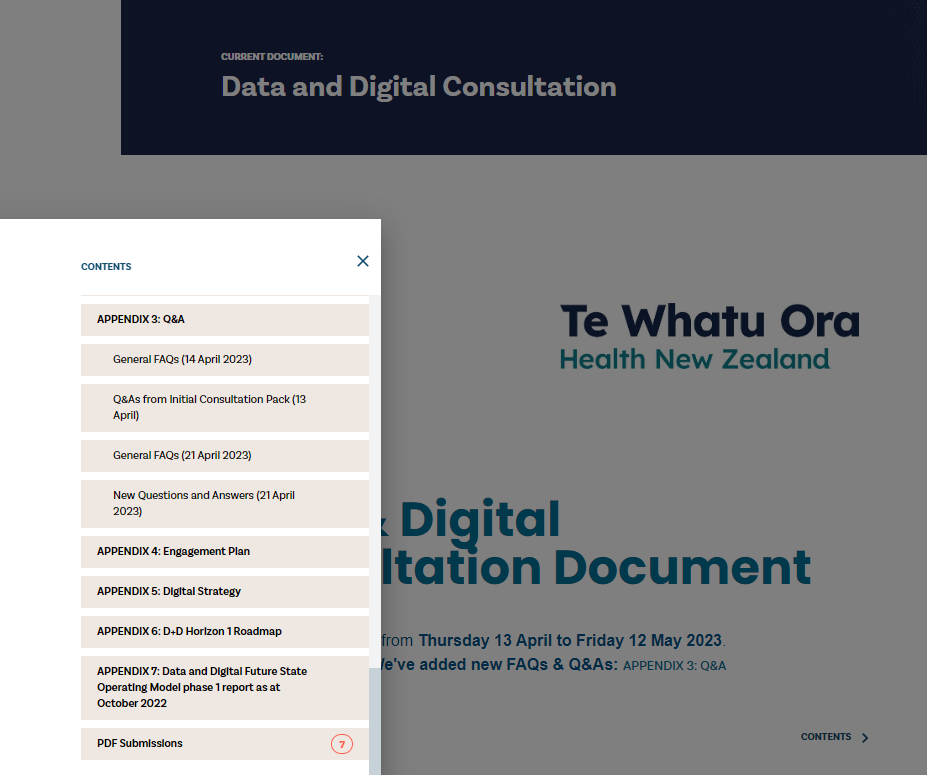
I was aware of this being developed and have seen parts of it at times shared with me by various people, but I’m wondering if there is a location where we can access the current version of the Digital Strategy and Roadmap, and also if there are more documents behind the Data and Digital Operating Model than what has been shared with the change proposal?

I have not been able to find these online on any Te Whaut Ora site, but perhaps they are there somewhere that I haven’t found.

I do plan to make one or more submissions on the Consultation Document, but it would be useful to have these other documetns available to view as we review the Consultation Document. That way can be better placed to comment on whether we think the changes proposed will help us achieve the stated goals or not, and help as make alternative suggestions where needed.

1 Like

@damon - dig into the appendices via What Say You D&D consultation, you’ll find the documents there

2 Likes

Great - thanks for the tip. The downloaded copy I was working off only went up to Appendix 4 so I hadn’t realised the WSY version had extra appendicies!

Any chance of a link to the consultation document as I can’t seem to locate it either - thanks very much.
kind regards
Gillian Robinson

Click on Contents and scroooooooll down to Appendices 4, 5, 6, 7, etc

@gill if you haven’t already accessed the Consultation Document as in @greg 's screenshot above, you can access it using the link in Lara’s post at the top of this thread. You do have to register for WhatSayYou first though before you can see it. To register you will need to use your “work email address” - I’m not sure if this means a government work email address. There is an option though to request access if you don’t have a work email address, so you could try this.

I’m not sure if there is a publicly available version of the document without registering for WSY. There are versions on local public hospital intranets, but the one I used didn’t have the extra appendixes that the WSY one has.

1 Like

Thanks @damon and @lara - I’ve been out in meetings all afternoon so will check via the link in the morning. Much appreciated.