Great questions and I defintely don’t have all the answers to them but I think I can help answer a few. @BeckyGeorge and @darren.douglass will be able to add more to the dialouge I am sure.
No, Hira isn’t aiming to be an integrated clinical information system or EHR. My undertanding is that this is very diliberate to move away from providing the user interface and workflow layer. There really hasn’t been much success in New Zealand in ever getting a monolithic or even fully best of breed system in most
Yes they will and the Hira team are working on a commercial model at the moment for this. Many of the organisations we as Clinical Informaticians work for will become both consumers and providers to Hira. Many in the sector are keen to understand the commercial model as it unfolds.
That seems to contains several question.
A. Quality of the underlying clinical systems. We all know this is mixed accross the sector and where there has been clear standards alongside some financial incentives (I am thinking National Enrolment services as an example) we have see some improvement in certain data sets. Hira will need to think about data aggregation and transformation for some use cases. I believe there is a pilot in Taranaki look at this for medications data.
B. How is it structured- the Hira team are just kicking off work on a Clinical Information Model which will be the standard for Hira information. Patrick Hindmarsh (not on this network, @BeckyGeorge would be great to get him on here) is responsible for this piece of work. I believe they are recruiting roles now and working on the sector structure to ensure the regions are a part of this. There is a lot internationally we can use here. The reality is though whatever the information model is- transformation and cleansing will be required.
C. Management on consent. My understanding that another one of the foundational capabilities will be consent management services that the Health Consumers control. I know very little about the scope of this work and if it will manage consent at a concept level like meds, versus problem list versus progress notes or if it will focus on at least empowering health consumers to see who is accessing their data and be able to grant and revoke access. This is going to be a big change for Clinicians and we do need to ensure we maintain the ability to access information for safe clinical care
D. High quality data- I think that will be essential as Hira’s key product is data. I think we all going to have to take responsibility for data quality and there will need to regional data goverance, data domain groups to address data quality issues. I promise you nothing like starting to serve up data to people for use to highlight data quality issues.
I am not sure Hira is wanting to get into to understanding all the workflows it will be supporting? Yes there will be core use cases to drive the initial requirements for the APIs but one of the ambitions of Hira is to enable sector innovation by access to re-usable data services that that you can combine into experience APIs to support different workflows.
In terms of how many data sources can be held together with APIs. Yes this is a good point. I have some very high level API pattern diagrams that I will dig up for this thread. The key thing is we will need to consolidate some data sets prior to exposing with an API and others we will have multiple APIs exposing the same data sets from different region (I am thinking of APIs over the Eclair data sets here.
I do think there are some good questions in this thread about the overall international experiences of doing what NZ is trying to do with Hira. There a certainly some smaller case studies that have some similarities but I haven’t yet found a case study that is close to what Hira’s scope appears to be.
The $385m in B21 was for cross-sector digital capability uplift so it included Hira tranche 1, but is also funding a national cybersecurity programme and investments to address technology debt. For example funding in the first bid round was approved for 27 DHB projects for things such as addressing poor hospital wifi and old network infrastructure and more end user devices. Bid round 2 for DHBs has just closed and a primary/community bid process is in planning. The cyber programme is putting more cybersecurity people in place across the sector including a primary care vCISO and deploying better end point protection. Basic stuff but it makes a real difference.
The $320m in B22 is more of the same but with a broader scope so it also includes digital enablement (some of you will be aware of the existing digital enablement programme initiatives that I think are making a real difference), innovation, data and analytics.
When I say national I definitely don’t mean just DHBs and one of the key questions the portfolio governance groups (those who recommend where to invest the funding) are grappling with is how to invest wisely in primary and community care.
I think Anna-Marie has covered off the Hira aspects and to confirm Hira is about making data accessible, not about workflow or applications. Its not a silver bullet and needs to stay focused on the problem of data access because that is complex enough in itself. Hira cares about workflow and digital solutions of course and wants to enable those who are designing workflow and applications to be able to do that based on trusted, reliable, accessible data. Hira does include non-technical considerations such as commercial structures, data standards, consent and delegation, privacy etc
Thanks Anna-Marie, your understanding of Hira (point 1) appears to be similar to mine i.e. not intended to address the significant gaps in hospital application software at the clinical workflow level, instead intending to providing an overall view of the available information. Obviously if you don’t have the data because it’s still largely on paper then you can’t display it hence my question should this ‘foundational’ problem not be the first priority?
Thanks for your other interesting comments. I don’t have anything to add except that they do highlight the enormity of the challenge ahead for Hira.
Chris
Thanks for this additional information Darren. I think this conversation highlights the enormity of the challenge for Hira particularly given the shaky foundations that need to be fixed first. The 155m allocated to Dunedin, if extrapolated across the rest of the country as a rough indication of what it takes to digitise a hospital, shows the scale of our foundational problems nationally.
It’s probably worth revisiting the scope of Hira vs. other required investments in digital.
Hira – as far as I’ve gleaned – is a set of standards allowing for aggregation of data from various sources of care in NZ. I’d rather Hira be a central source of truth that does all the aggregating and cleaning, then allowing secure access, but it doesn’t appear this is the case.
The investment in data and digital as required by individual institutions is another matter entirely. This is where the inefficiencies of care, the dropped follow-up, the staff burn-out, and the threats to patient safety emerge – and major centers across the country are all doing their own bespoke thing. Down here in Christchurch, we remain on a hybrid of paper and electronic systems, including two parallel systems for viewing clinical information and documenting (Orion and Cortex), the ongoing mess of attempting digital prescriptions, not to mention other systems hanging off to the side like ERMS, Eclair, HealthOne, our bespoke ED dashboard, etc. This is fine in the sense the journey from paper to fully digital systems is slow and meandering; what is not fine is how much duplication of effort the must certainly be between various hospitals. If Dunedin is investing $150M to develop a fully-integrated digital system with all the hooks and APIs to allow seamless transitions in care back to the community, every institution in NZ should be looking to reuse the products of this investment.
If anything is frustrating and nonsensical to me, it’s how many different models of care exist in a country this small, and with finite resources to invest …
Thanks @rradecki for the example from Finland. It would be great to have someone from Finland talk at the HINZ conference in December about this - I wonder what the chances of that are? Even if it’s a virtual presentation to save on travel, but still allow for Q and A.
Don’t get too excited about Finland! See Matt’s post above:
It might be better to invite someone from Estonia!
Don’t forget about Discourse’s excellent quote feature. It is a great way to let others know what you are referring to - and to reply to multiple folk / questions in a single post.
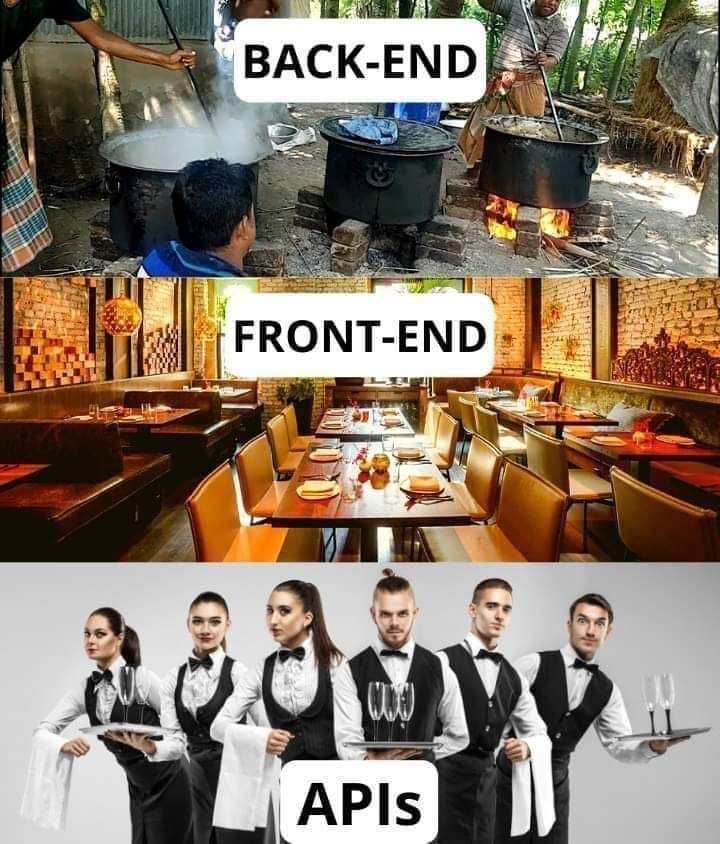
Darren’s separation of concerns is critical to understanding the scope and purpose of Hira. This image, posted by @karl (I think) on LinkedIn, presents a nice, basic representation of the role of APIs…