Clinical / Technical resource sharing in Aotearoa NZ - what should we do about it?

Hi everyone. I missed this thread so apologies for the late contribution.

I thought it might be useful to link the info below which I have permission to share. This is a list of the jointly developed interdisciplinary task workflows, clinical document templates, dynamic care plans and clinical summary templates that are intellectual property of Te Whatu Ora, deployed on the Cortex platform.

This export was from Jan 2023. There are -

  • 415 Clinical Document templates
  • 20 unique “living document” care plans
  • 179 unique task workflows
  • 95 order/internal referral templates
  • 12 clinical “living document” summary templates

Over the last 2 years, Te Whatu Ora clinicians of all disciplines have worked together to create a significant national resource which has the potential to jump-start consistent large scale clinical data collection across the motu.

Te Whatu Ora Waitaha - Cortex Workflows.xlsx (20.7 KB)

4 Likes

Having been part of their development and significant impact, i wanted to highlight that much of the work in Cortex is standards based for information content as well. Providing a robust platform for multi site benchmarking and analytics.

Thanks @Alistair . This is an interesting list, but given that it just provides names and classifications, can you explain what form the actual document templates, care plans, and workflow definitions are kept in.

I note that the Te Whatu Ora web site doesn’t have a lot of information about the Cortex platform (well none that I can find - everything searchable to me shows it only in relation to Canterbury DBH ;). Is the system, or processes being used, or planned for wider use in the national health system now? Or is the IP of Te Whatu Ora just a result of the nominal takeover of the DHBs by the national organisation?

Thanks in advance,
Keith

Hi @keithduddy

If you look thorough the spreadsheet, the “note” references are probably of most interest.

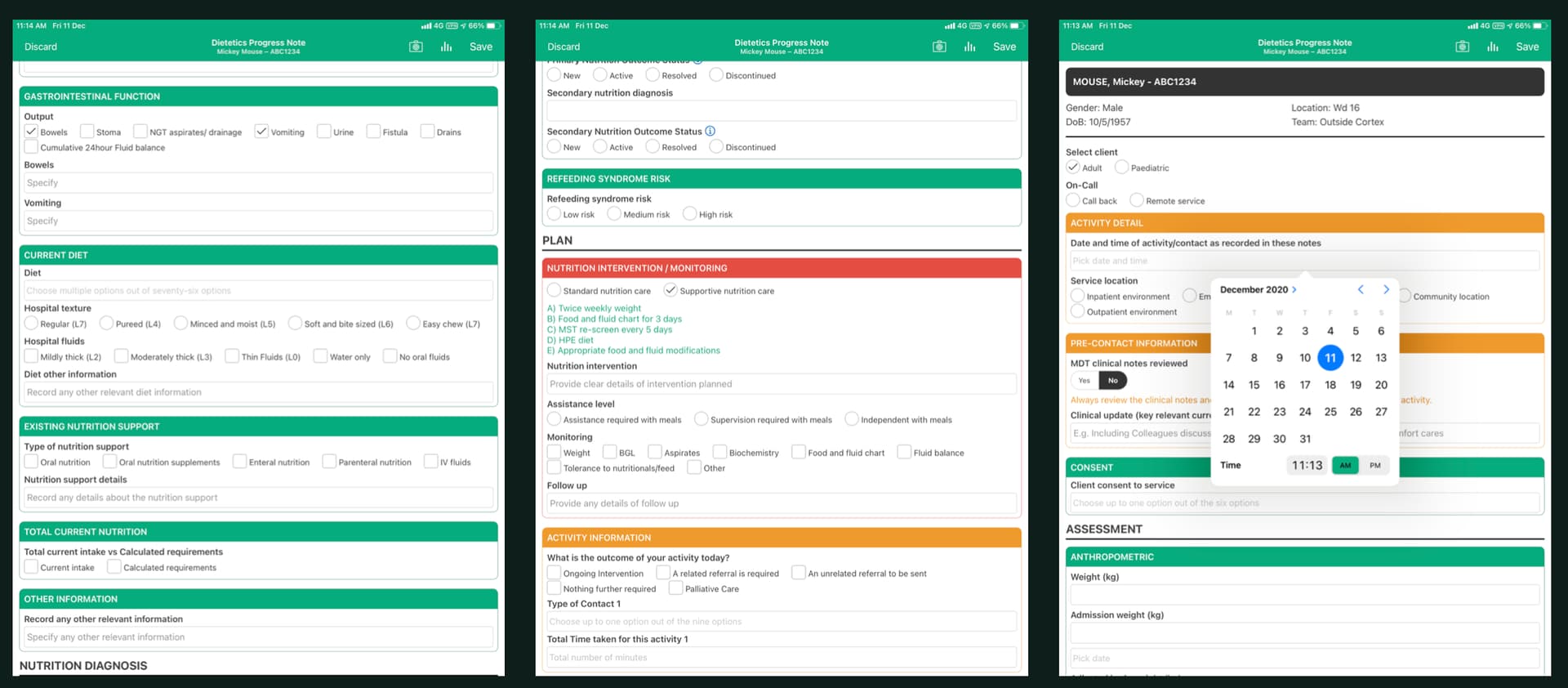
These are interdisciplinary templates which collect structured data via free text, radio options, checklists, drop downs, tokenised data, data lookups, date pickers, SNOMED coded fields and images - with conditional rules allowing for clinical decision support and granular choice of what is collected vs what is shown. Some examples below.

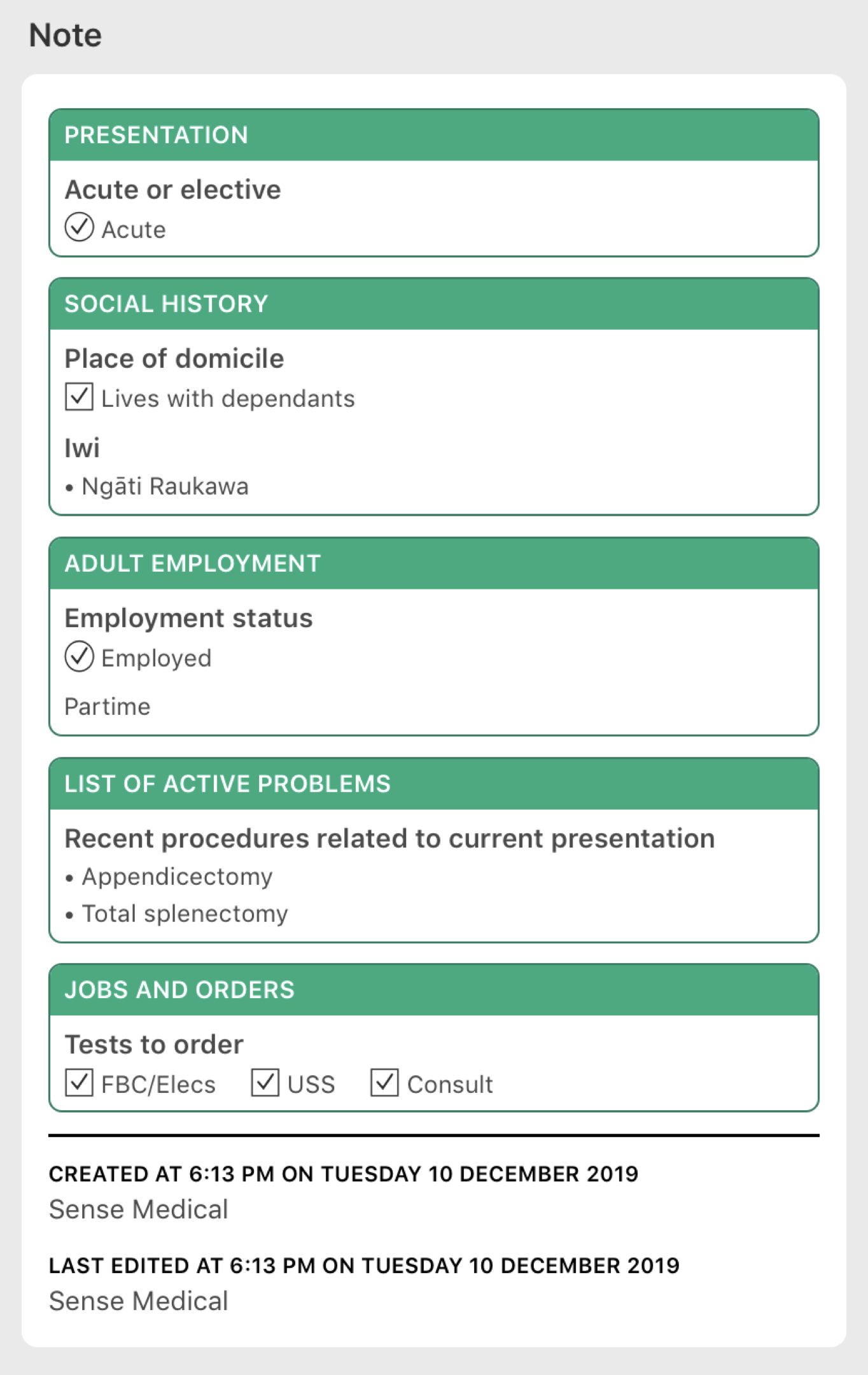
With regards to the data - here’s a very simple form’s output.

The data is all encoded in JSON and available in real-time for an organisation to cut and slice as they see fit. All data fields are keyed and there is organisational and toolkit governance to ensure consistency of this. Here’s an example of what the data looks like for a specific component in the form above (“Iwi”)

"form_data": {
  …
  "iwi": {
	"type": "value_matrix", 
	"value": [
      [{"id": "2106", "label": "Ngāti Raukawa", "custom": false}]	
	]
  }
  …
}

At Christchurch the Decision Support Unit is now doing some sophisticated regular analysis of free text data and feeding back to clinician workflow creators e.g.

"We’ve reviewed the free text content of this particular component in these particular forms and can see common repetition of information

“Thanks - I’ll convert that information into an options component to create categorical data and speed up entry of data”

A new version of the workflow is then deployed - all via internal organisation processes.

With regards to Te Whatu Ora - although previously the DHB silos made resource sharing a bit tricky, we are all now a national team. With this new perspective, Te Whatu Ora now has access to the output of a significant investment by doctors of all specialties, nurses, allied health and quality specialists working together over the last 2 years at Waitaha Canterbury to define and develop a significant workflow resource that is truly interdisciplinary in its design.

2 Likes

Thanks for that Alistair…

@jon_herries - this doesn’t seem to exist when I click on it. Is the link right? And could you please add me (nathan-nz)?

This sounds great, Alistair - this is an excellent example of forms iterating their way to excellence. Is there a way that you could meaningfully share the current iteration of each form?

I guess that might be tricky where things are very organisation-specific, or if you have multiple versions in different organisations.

It would be absolutely brilliant to have a repository of the ‘gold standard’ for each form that could simply be locally tweaked if needed.

@NathanK - I like that phrase… “iterating to excellence”

Re a repository - essentially it exists already. The form designs are IP of Te Whatu Ora. They are all stored within the Te Whatu Ora Waitaha Cortex instance as JSON documents + there is an import/export function for cross organisation Cortex sharing - no need to rinse/repeat the work that’s been done.

We have functionality we’re ready to release that allows for cross-workflow master resources. e.g. the way to ask a smoking history - a workflow builder in Cortex Designer will be able to drag and drop the Smoking History resource (built by interdisciplinary clinicians) into whichever workflow template it’s needed with everything keyed consistently and SNOMED-CT coded - ensuring data consistency at scale regardless of speciality or use case.

The inherent value though is the interdisciplinary clinical investment in creating this IP. That’s the most exciting part of this whole journey.

2 Likes

There’s quite a focus on forms here - clearly the evolutionary stage we’re at (mostly). I think one of the challenges we need to focus on is data retrieval. Forms are an obvious mechanism for data capture, but at present, we’re more or less locked in to viewing/retrieving data in the form it was captured in.

We’re still often only digitising paper (as artefacts of various clinical processes). There’s significant duplication/replication across these forms given each tends to be developed as an individual piece of work. Many of the person-level elements, ubiquitous across most forms, are not yet centrally stored or managed in a usable way, and as such, each form is often a snapshot/silo, only viewable by opening that form. In the wider context (i.e. including non-inpatient areas), medications, alergies and alerts, conditions/diagnoses, medico-legal, family violence screening, smoking cessation, personal preferences/needs/supports, dependents etc are all aspects of person-level information routinely captured in silos across a multitude of forms. Further, we have an over reliance on finding (in our digitised paper file) and opening discharge summaries as our main source for previous history. We have limited local contextual views of information able to be generated from data captured across our array of forms, let alone any person-level equivalents available wherever a person may present.

Smoking cessation is an interesting one. There is a national requirement to capture and report these data, along with national guidance around when and what is to be captured, yet like many such things, interpretation and variation has pervaded. Standards are only part of the solution, with the main issue being multiple repositories of the same person-level data (at a form level, application level, provider level, district level, regional level - depending on the service location). Interoperability is also only part of the solution, as this suggests being able to exhange data between silos in a standardised way. Obviously this is critically important, however in the case of many of the elements noted previously, reducing the silos - and in fact, establishing core repositories of commonly utilised data would seem like something we should be aiming for.

I agree that sharing ideas and examples would be great - particularly specific aspects around data integration, management and retrieval. I’m not sure there’s huge value at this point in sharing forms, given that array of tools and subjective content variation that exists.
3 Likes

Hi Ryan,

100% agree with everything you’ve said.

The Waitaha experience is a little bit more than just digitising paper - manly due to the way the interdisciplinary team has worked together to design things.

As a rule, we actually talk about “workflows” rather than forms - reflecting where we see things evolving over the next few months.

“Resources” are an intermediate solution, the next step will be true FHIR components in Cortex Designer that will allow for both collection + display of FHIR encoded data relevant to the workflow.

That’s where things will start to get super exciting as that data, being read/write, is available across the ecosystem.

We’ve chatted with the HIRA team about this, there are a number of core pieces of longitudinal data that require a central FHIR based repository of truth - most of which you’ve listed.

Problem lists are going to be the most important. If we can get that right then it will open up huge opportunities for innovation across Te Whatu Ora Data and Digital as pretty much every encounter with the health system either needs access to that info or results in a change to it.

3 Likes

Within the Cortex instance? That isn’t much help for those (i.e. most) who are using other products.

In contrast, I’m suggesting a proper repository of basic form design which can be utilised by all regardless of software vendor - and then this is ‘iterated to excellence’. Idealistic, and will never be possible until we stop keeping this stuff / data inside vendor products.

Hi Nathan,

The “repository” and IP isn’t so much in how this resource currently technically exists in a specific platform (although of course it’s a straight forward lift and shift if the same platform is utilised) - it’s the interdisciplinary clinical investment that’s been undertaken in designing the workflows where enormous value lies.

The questions asked, the options available, the tips and advice attached to components, the conditional rules about what to show dependent on previous inputs etc etc - this is clinical informatics and reflects literally 1000s of hours of work by New Zealand clinicians who understand the needs of their colleagues and patients.

I (naturally) have strong feelings about the best way to utilise this IP :wink:, but the main reason for jumping into this thread is to ensure that folks are aware of the breath and depth of knowledge and work that has been undertaken by Te Whatu Ora clinicians over the last few years and the shared resource that has resulted from this.

3 Likes